
.jpg)
Picking an AI avatar API is only half the decision. The other half is what happens to the video once the avatar is done talking.
Every avatar API, regardless of architecture, outputs raw video. The avatar performance is there. What isn't: captions for social reach, brand overlays for recognition, trimming for pacing, and rendering at the resolution each platform needs. That gap between raw avatar output and social-ready content is where most pipelines stall.
This guide breaks down the three avatar API architectures developers are building on right now, which one fits your use case, and how VEED's API closes the gap at the end of each pipeline, turning raw avatar video into content that's ready to perform on social.
Key takeaways:
- AI avatar APIs fall into three architectures: pre-rendered video, real-time streaming, and open-source or self-hosted
- HeyGen LiveAvatar and Tavus CVI lead the real-time space for conversational, two-way avatar experiences
- D-ID and Synthesia are stronger for scripted, pre-rendered avatar video at scale
- Every avatar API outputs raw video; captions, branding, trimming, and platform-ready rendering are a separate step
- VEED's API handles that finishing step for any avatar pipeline, so the output is social-ready, not just generated
How we selected these avatar APIs
The APIs covered here were selected based on developer adoption: search volume, GitHub activity, documented production use, and SDK maturity. We focused on platforms actively used in shipped products. Each section covers what the API is built for, where it falls short, and how VEED fits in at the end of that specific pipeline to get the output ready for social.
Pre-rendered avatar APIs: D-ID and Synthesia
Pre-rendered avatar APIs take a text script or audio file and return a finished talking-head video asynchronously. You submit a job, get a job ID back, and retrieve the output via polling or webhook when rendering completes. Latency is measured in seconds to minutes, not milliseconds.
This architecture suits workflows where the avatar doesn't need to respond to a live user: onboarding flows, localized marketing assets, e-learning modules, product demos, and scripted social content. The avatar delivers exactly what the script says, rendered at whatever volume the pipeline needs.
D-ID
D-ID's generative AI API accepts text or audio and returns high-resolution video through its Creative Reality infrastructure. It supports REST APIs, WebRTC, and JavaScript SDKs. Its core strength is scripted talking-head generation, and it supports real-time language switching for teams producing content across multiple markets.
Synthesia
Synthesia exposes an API for generating avatar videos programmatically at scale. Its stock avatar library covers a wide range of personas and languages. Custom avatar support is more limited compared to newer real-time platforms, but for high-volume scripted content pipelines, it's a reliable option.
What's still missing from the output
D-ID and Synthesia both return raw video files. The performance is complete, but the asset isn't ready to post. There are no captions for reach and accessibility, no brand fonts or overlays, no trimming, and no platform-specific rendering. A talking-head video without subtitles loses a significant share of social engagement, since most social video is watched without sound.
This is where VEED's API picks up. Pass the rendered avatar video to VEED and it can auto-generate captions with accurate word-level timing via the lip sync API, apply branded subtitle styles in your font and color scheme, remove or replace the background, trim silence and dead frames, and export at the resolution and aspect ratio each platform needs: vertical for Reels and TikTok, square for feeds, widescreen for YouTube. One post-processing call converts a raw avatar file into a social-ready asset.
For pipelines generating hundreds or thousands of avatar videos per day, that call runs automatically on every job output. Every video ships captioned, branded, and trimmed, without a manual editing step.
Real-time streaming avatar APIs: HeyGen LiveAvatar and Tavus CVI
Real-time streaming avatar APIs use WebRTC to deliver low-latency, bidirectional audio and video between a user and an AI avatar. The avatar listens, processes input through an LLM, and responds with synchronized lip movement, expressions, and gestures, typically within a few hundred milliseconds. This is the architecture behind live virtual assistants, conversational agents, interactive kiosks, and digital hosts for live events.
HeyGen dominates the search volume in this category. Tavus is the more technically differentiated option for use cases where perception matters as much as response speed.
HeyGen LiveAvatar
HeyGen's LiveAvatar is the successor to its Interactive Avatar API, which sunsets March 31, 2026. LiveAvatar streams AI avatars using WebRTC with sub-second response times. Developers connect it to their own LLM or HeyGen's built-in knowledge base, and the avatar responds with natural lip sync, head motion, and expressions.
The SDK manages bidirectional audio and video, interruption handling so the avatar stops talking when the user starts, and voice activity detection. Quality settings run from 360p at 500kbps to 720p at 2000kbps. Access tokens should always be generated server-side.
HeyGen LiveAvatar fits best for:
- Live virtual assistants embedded in web and mobile products
- Digital hosts for virtual events and live broadcasts
- Real-time customer support agents with a visual presence
- Sales and onboarding agents that respond in the moment
Tavus Conversational Video Interface (CVI)
Tavus is built for two-way, face-to-face AI conversations where the avatar reads more than just audio. Its Raven-0 perception model interprets visual cues from the user, detecting emotion and body language in real time. Sparrow-0 handles natural turn-taking so dialogue flows rather than alternates.
Tavus is also VEED's avatar technology partner. VEED integrated Tavus APIs to bring personal avatar creation to its platform, letting users generate realistic AI avatar videos directly inside VEED.
Starting a Tavus conversation is a single API call that returns an embeddable URL. Digital twin replicas train from roughly two minutes of video and audio. Tavus supports bring-your-own-LLM for teams with an existing AI layer.
Tavus CVI fits best for:
- Educational agents and AI tutors that read student engagement visually
- Healthcare intake and coaching tools where visual presence builds trust
- Personalized sales outreach using a custom digital twin
- High-volume personalized video generation via its Phoenix-3 rendering model
What happens to the recording after the session
Live avatar sessions are regularly recorded for reuse: event replays, training archives, support summaries. When a session ends, what you have is raw video. No captions, no branding, no trimming. For a recording to perform on social or hold its value as a content asset, it needs the same finishing work as any other video.
VEED's API handles that step. Auto-generate captions using the subtitle editor API, apply brand overlays and lower-thirds, trim the session to the relevant segments, and export at the format and aspect ratio your distribution channel requires. A recorded HeyGen or Tavus session goes from raw file to publishable content in one automated step, without opening an editor.
Open-source avatar models: LivePortrait and Alibaba live avatar
A segment of developers evaluates self-hosted models before committing to paid APIs, particularly teams building at volumes where per-minute API costs compound significantly. LivePortrait and Alibaba's live avatar research are the most-cited open-source options, with active GitHub communities and documented production use cases.
The tradeoff is real: self-hosted models require GPU infrastructure you own and operate, engineering effort to integrate and maintain, and no production SLA. At low to moderate volume, managed APIs usually win on total cost. At high volume with dedicated ML engineering capacity, the math can shift.
The core question is whether your infrastructure cost at your expected video volume is lower than the per-minute or per-frame cost of a managed API. That comparison changes significantly depending on video length, generation frequency, and how GPU costs are amortized across your stack.
Post-production still applies
Open-source models output raw video files, the same as any managed API. Captions, brand overlays, and platform-specific rendering still need to happen before the content is ready to publish. VEED's API works the same way with open-source output as it does with D-ID or HeyGen output. Pass the video file, specify the processing steps, receive a social-ready asset. The post-production layer is pipeline-agnostic.
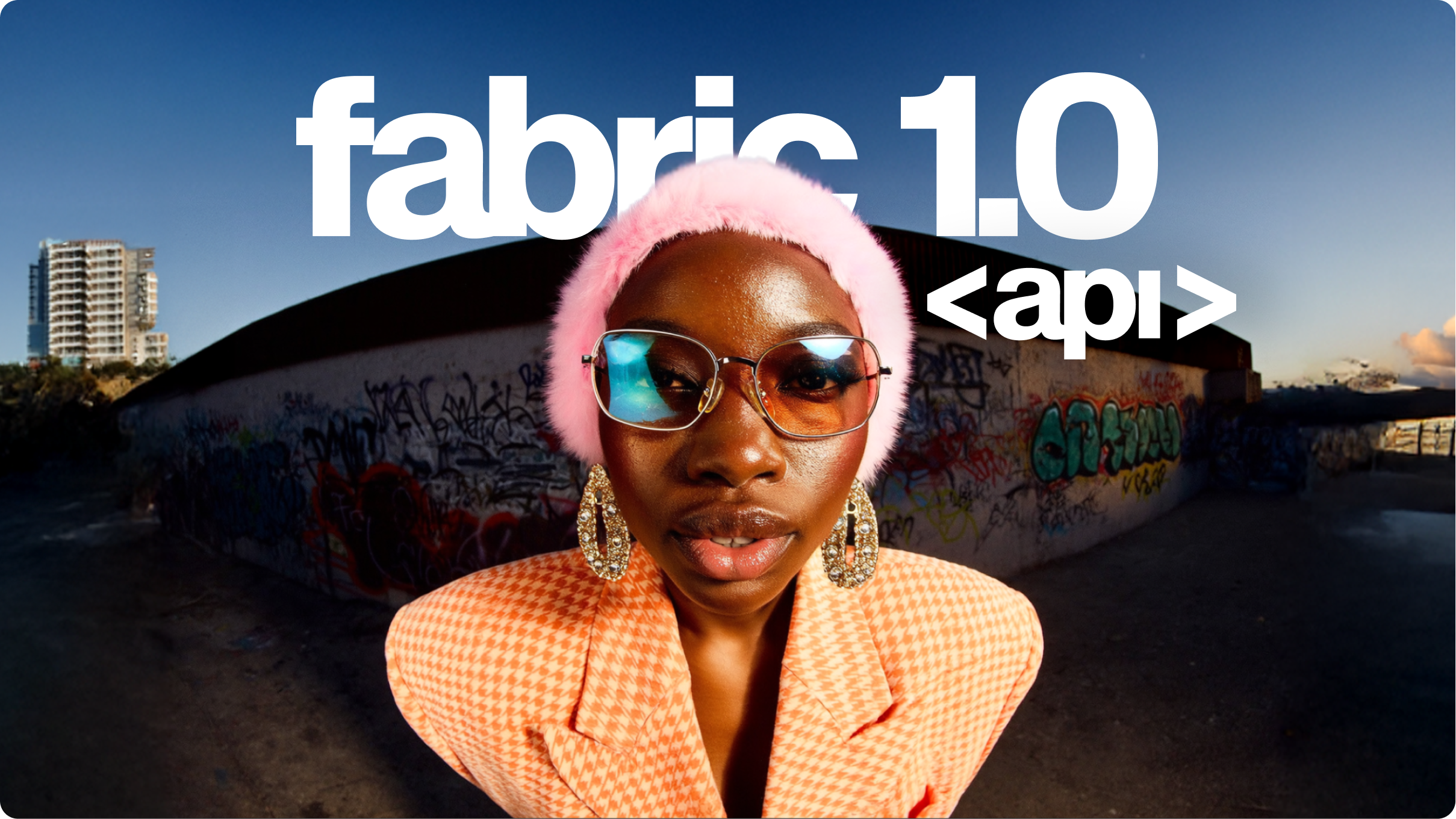
VEED's Fabric 1.0 API: create any avatar, not just stock ones
Most avatar APIs restrict developers to preset avatar libraries. If you need a branded mascot, custom character, or any visual style outside a photorealistic stock human, the options narrow fast. VEED's Fabric 1.0 API is built for that gap.
Fabric 1.0 takes a static image and an audio file and returns a talking video with natural lip sync, head motion, and expressive body movement. It supports any visual style: photorealistic portraits, anime characters, clay animations, branded mascots. Videos can run up to five minutes, which is longer than most image-to-video APIs allow.
Because Fabric 1.0 is part of VEED's API ecosystem, the same pipeline that generates the avatar video can immediately apply captions, remove the background, and render for each platform, all within VEED. There's no handoff to a separate post-production tool.
Fabric 1.0 fits best for:
- Brands that need a custom visual identity, not a stock persona, as their avatar
- Gaming studios animating NPC dialogue with original characters
- Content localization workflows dubbing the same branded character across languages
- Platforms creating personalized video at scale where each user gets a unique character experience
Text-to-speech avatar pipelines: where VEED fits across the full stack
The most common avatar pipeline is text-in, social-ready-video-out: a user submits text, an LLM generates a response, a TTS engine converts it to audio, an avatar API animates the audio into a talking-head video, and a post-production step makes the result publishable. Most implementations are missing that last step.
VEED covers both the TTS layer and the finishing layer. The AI voice generator converts text to natural-sounding speech, which can pass directly to Fabric 1.0 or any external avatar API for animation. The output then runs through VEED's post-production APIs: captions, background removal, brand overlays, platform export. The full pipeline, from text to social-ready avatar video, can run inside a single VEED API workflow.
.png)
.png)