Best Lip-Sync API for AI Video: How VEED Fabric 1.0 Compares to the World's Top Models (2026)
Choosing the right lip sync API has never been more consequential, or more confusing. The market has exploded with options that all make similar claims about realism, speed, and ease of integration. Put them side by side in production conditions, and the differences become impossible to ignore.
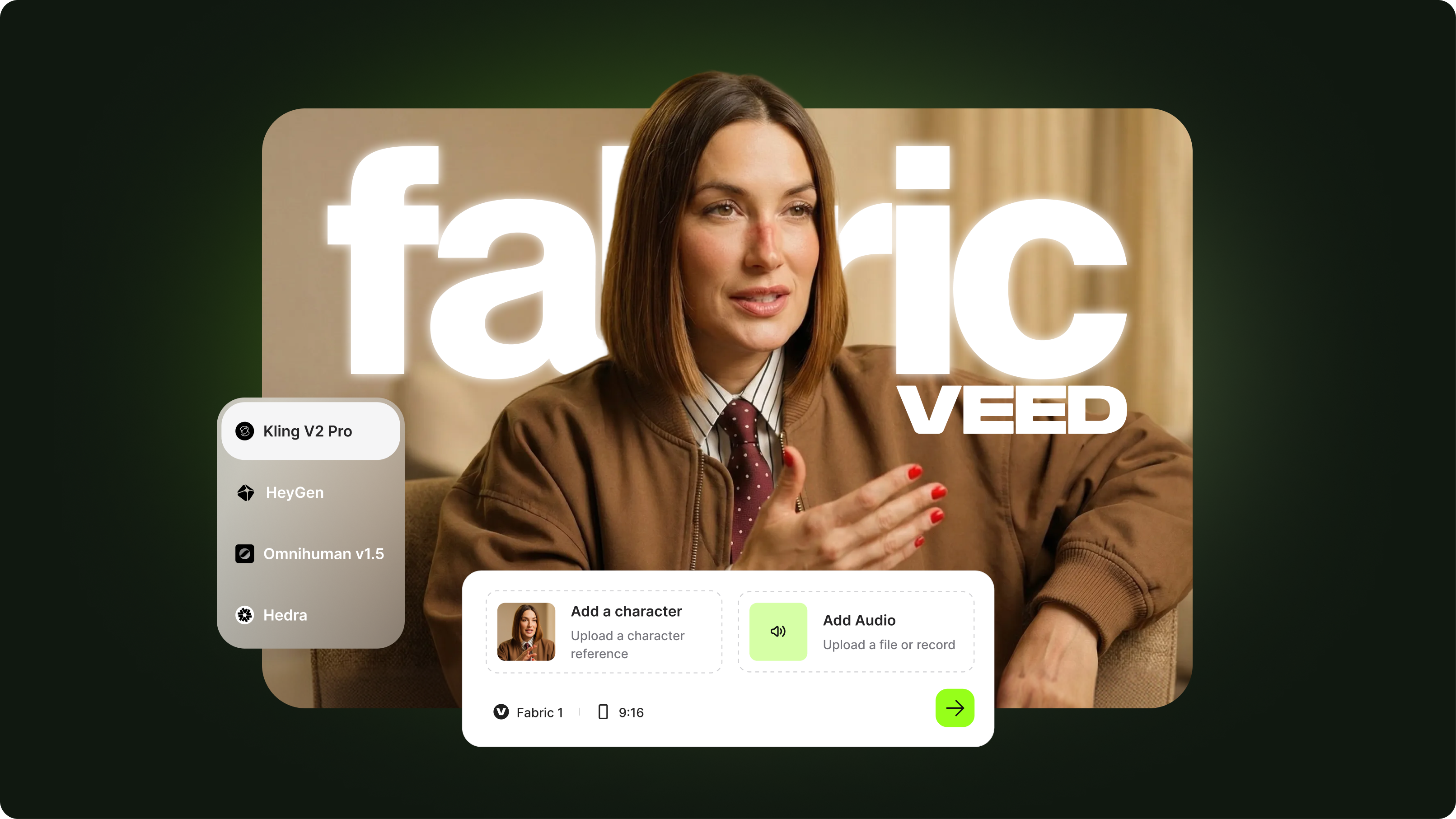
This guide cuts through the noise with a direct comparison of the top lipsync APIs in 2026, grounded in real benchmark data. We tested VEED's Fabric 1.0 model against five major competitors: Kling V2 Pro, HeyGen, Creatify Aurora, Omnihuman v1.5, and Hedra. We measured generation speed, cost per second, lip sync accuracy, and overall avatar realism.
Whether you're building a content automation pipeline, scaling personalized video for marketing, or evaluating APIs for a product integration, this breakdown gives you the data to make the right call.
Summary / Key Takeaways:
- VEED Fabric 1.0 is the fastest lip-sync model tested, generating video up to 68% faster than leading competitors
- Fabric 1.0 leads on lip-sync accuracy, micro-expressions, and natural body language — the three factors that most affect avatar realism
- HeyGen and Hedra offer cheaper per-second pricing, but lag significantly on generation speed and output quality
- For production workflows where speed and realism matter, Fabric 1.0 offers the strongest overall value at $0.15/sec
- Choosing the right lip-sync API depends on your use case: budget-first projects may suit Kling or HeyGen, while brand content and paid ads demand Fabric-level quality

Comparison of World’s Top LipSync Models
VEED Fabric 1.0 vs. Kling V2 Pro
Kling is cheaper at $0.115/sec vs. Fabric's $0.15, but 68% slower at 139 seconds. Fabric also produces more precise phoneme tracking, avoiding the "floating mouth" artifact common in Kling outputs. For teams running high-volume pipelines, Fabric's speed and consistency make it the stronger choice.
Verdict: Kling saves a few cents per second. Fabric saves time and produces better lip-sync.
VEED Fabric 1.0 vs. HeyGen
HeyGen is the cheapest per second at $0.10, but the $100/month API minimum changes the cost equation for lower-volume use. It's also the slowest model tested at 167 seconds — nearly three times Fabric's generation time. Facial movements can appear templated, particularly on harder consonants.
Verdict: HeyGen wins on price. Fabric wins on speed, realism, and workflow efficiency.
VEED Fabric 1.0 vs. Creatify Aurora
Pricing is almost identical — Aurora at $0.14 vs. Fabric at $0.15 — but Aurora takes 166 seconds to generate vs. Fabric's 63. Aurora also presents with more rigid posture and less natural head movement, making the output read more like an avatar than a person.
Verdict: Near-identical pricing with a 62% speed gap. Fabric is the obvious choice.
VEED Fabric 1.0 vs. Omnihuman v1.5
Omnihuman is more expensive ($0.16/sec) and slower (118s vs. 63s). The quality gap shows in micro-expressions — small eyebrow shifts, lip tension, and cheek movement — where Fabric consistently outperformed. These details are what separate convincing digital humans from obvious AI video.
Verdict: Fabric is cheaper, faster, and more expressive. No scenario favours Omnihuman at current pricing.
VEED Fabric 1.0 vs. Hedra
Hedra is roughly 50% cheaper, and the quality reflects it. Common output issues include over-smiling, excessive head tilting, and inaccurate lip-sync on complex phonemes. It's also 31% slower than Fabric. For internal or low-stakes content, the trade-off may be acceptable. For anything public-facing, it isn't.
Verdict: Hedra suits tight budgets with low realism requirements. For brand content, Fabric is worth the premium.
How to choose the right lip-sync API
Optimise for speed and workflow efficiency
🥇 Best choice: VEED Fabric 1.0 — At 63 seconds average generation, it's the fastest model available. For high-volume pipelines, that compounds quickly.
🥈 Runner-up: Hedra — Second fastest at ~91 seconds, but with notable quality trade-offs.
Optimise for realism and brand safety
🥇 Best choice: VEED Fabric 1.0 — Leads on lip-sync accuracy, micro-expressions, and natural body language. Essential for paid ads, customer-facing content, and branded video.
🥈 Runner-up: HeyGen — Competitive avatar quality but slower generation and more templated movement.
Optimise for lowest cost
🥇 Best choice: Hedra — Roughly 50% cheaper per second. Works for high-volume, low-stakes content.
🥈 Runner-up: HeyGen — $0.10/sec, but requires a $100/month API minimum and delivers the slowest generation times tested.
What makes lip-sync quality hard to evaluate
Most comparisons focus on price and feature lists. The factors that actually determine whether your content works are harder to quantify.
- Phoneme-level tracking is the key differentiator. The best AI lip sync API models map mouth positions to individual speech sounds, not just broad shapes, avoiding the floating-mouth effect on difficult consonants. This is Fabric's core technical advantage over lower-quality models like Hedra.
- Micro-expressions matter more than most buyers expect. Eyebrow movement, lip tension, and cheek engagement are what make a face feel inhabited rather than animated. Without them, even technically accurate lip-sync reads as artificial.
- Body language is increasingly important as viewer familiarity with AI video grows. Rigid posture and fixed head positioning signal "avatar". Natural motion — even subtle — changes how content is perceived and how much authority the avatar carries.
Best practices for production use
- Write for spoken delivery. Conversational scripts with shorter sentences and natural pauses perform better than written prose read aloud.
- Match resolution to channel. 720p suits most social and web distribution. Factor resolution options in if producing for large-format display.
- Build in quality review. Even strong models produce inconsistent outputs. Sample-check generated videos before committing to full-batch production.
- Add transcripts for SEO. AI platforms read transcripts, not video. Accurate transcripts via VEED's video transcription tool improve discoverability.
- Start with lip-sync video creation. New to AI lip-sync? This guide to creating lip-sync videos with AI walks through the process end to end before you commit to an API integration.
- Keep post-production in one place. VEED integrates Fabric generation with video editing and subtitle tools, reducing integration complexity.
Final thoughts
- Speed: Fabric is 46–68% faster than every competitor tested
- Realism: Fabric leads on lip-sync accuracy, micro-expressions, and body language
- Price: Mid-range at $0.15/sec — cheaper than Omnihuman, more than HeyGen and Hedra
- Value: When speed and quality are factored together, Fabric delivers more usable output per dollar than any model tested
The real question isn't 'what's the cheapest API?' It's 'what's the cost of slow generation and poor quality on my workflow?' On that measure, Fabric's combination of speed and realism is the strongest option available. See VEED's lip sync API to get started.
FAQ
VEED Fabric 1.0 is the strongest performer across speed, lip-sync accuracy, and avatar realism. It generates 720p video in around 63 seconds and leads all tested models on micro-expression detail and natural body language. Budget-first projects may find Hedra or HeyGen more appropriate depending on quality requirements.
Fabric is 62% faster (63s vs. 167s) and produces more natural facial movement and lip-sync. HeyGen is cheaper at $0.10/sec but requires a $100/month API minimum and delivers the slowest generation times tested. For production workflows, Fabric's speed and realism advantages outweigh the price difference for most use cases.
A lip-sync API animates the mouth and facial movements of an existing avatar to match audio. An avatar API generates the digital human itself — covering appearance, body language, and overall presentation. The two are closely related: lip-sync quality is one of the most important factors in how realistic an avatar looks on screen.
Kling is slightly cheaper at $0.115/sec but 68% slower (139s vs. 63s) and produces less accurate lip-sync with more floating-mouth artifacts. Fabric is the stronger option when quality and speed matter. Kling suits teams with flexible timelines and tighter per-second budgets.
Prioritise generation speed, per-second cost, phoneme-level lip-sync accuracy, micro-expression quality, and body language naturalness. Also check API plan minimums (HeyGen requires $100/month), resolution options, and integration with post-production tools. Match these to your use case — realism matters most for branded content; cost-per-second matters most for high-volume, low-stakes output.