Summary / Key Takeaways:
- UGC stands for user-generated content: any media created by real users and customers rather than by a brand, including reviews, photos, social posts, and video.
- "UGC" hides two different things: authentic content from real customers and UGC-style or AI UGC made deliberately for ads. They look similar and work differently.
- UGC works for brands because it builds trust, adds social proof, supports SEO, and converts, often better than polished brand ads.
- Brands cannot manufacture authentic UGC, but they can source it, run campaigns to generate it, get the rights, and moderate what they collect.
- AI UGC produces UGC-style video fast, but the value is in the finishing: making it look like your brand, not AI, before it goes out under your name.

User-generated content is a highly recommended marketing tactic that most teams still cannot reliably produce. Everyone agrees real, relatable content outperforms polished brand ads. Then the content calendar arrives, the team is two people, and "go get authentic customer video" turns out to be much harder than it sounds.
Part of the confusion is the term itself. "UGC" gets used for two different things: the genuine reviews and posts your customers make on their own, and the UGC-style videos brands commission or generate to run as ads. They look alike in a feed. They are produced in completely different ways.
This guide starts with what UGC is and why it works for brands, then covers the types, real examples across platforms and industries, and the strategy side that the definitional guides skip: running campaigns, getting rights, moderation, and SEO. It then goes deeper than most guides on AI UGC, how it is produced and how to finish it so it looks like your brand instead of generic AI. By the end you will know what counts as UGC content, what doesn't, and exactly how to put it to work.
What is UGC?
UGC stands for user-generated content. It is media created and published by real users or customers rather than by a brand. The full form is the giveaway: a user generated it, not the company. It includes reviews, ratings, social media posts, photos, videos, testimonials, comments, and forum threads. The defining trait is the source, a person who is not on the brand's payroll.
That source is exactly why it works. Audiences read UGC as a recommendation from someone like them, not a message from a company trying to sell to them. It carries social proof that brand-made content cannot manufacture on its own.
UGC vs influencer content vs brand content
These three get mixed up constantly, so here is the clean distinction:
- Brand content is made by the company or its agency. Full control, low perceived authenticity.
- Influencer content is made by a paid creator with their own audience. The reach is rented and the endorsement is disclosed as paid.
- UGC is made by everyday users or customers. The value is that it reads as genuine and relatable, whether it was posted organically or commissioned to look that way.
The last point matters. A lot of what marketers call UGC today is not spontaneous. It is UGC-style content, made on purpose to feel native. More on that below.
Why UGC works for brands
UGC works because people trust other people they can relate to more than they trust brands. When a viewer sees content that looks like it came from someone in their position, they lower their guard, and the message lands as advice instead of a pitch.
The benefits stack across the funnel:
- Trust and authenticity. Real voices and real settings feel credible in a way studio ads do not.
- Social proof. Seeing other customers use a product reduces the fear of getting it wrong.
- Cost and scale. Organic UGC is created by your audience, so it does not carry a production budget.
- SEO. Reviews, ratings, and user posts add fresh, keyword-rich content to product pages, which can improve search visibility and feed rich results.
- Conversion. Native-looking content stops the scroll, and authentic endorsements reduce hesitation at the point of decision. It is a big part of why UGC can outperform influencer ads on cost per result.
The trust advantage is well documented: Edelman's 2025 Trust Barometer found that 80% of consumers now look to peers rather than brand experts as their standard for accurate information about a brand.
The main types of user-generated content
UGC comes in several formats, and most brands use a mix. Here are the types you will actually work with:
- Reviews and ratings. The original UGC. Star ratings and written reviews on product pages, app stores, and marketplaces.
- Social posts and photos. Customers tagging your product in their feed, stories, and photo dumps.
- Testimonials. A customer describing their experience, in writing or on camera.
- Video. Unboxings, demos, tutorials, and talking-to-camera clips. The format pulling away from the rest.
- Community content. Questions, answers, and discussions in forums, comment sections, and groups like Reddit.
Why video is the dominant UGC format now
Video UGC is the dominant format because it feels native in the places people spend their time, like TikTok, Instagram Reels, and YouTube Shorts. A talking-to-camera clip or a quick demo demonstrates value in seconds and fits the feed without looking like an ad.
That is also why video UGC is the hardest type to produce at scale. Reviews accumulate on their own. Scroll-stopping video does not. This is the gap where most teams get stuck, and where UGC-style and AI UGC come in.
UGC examples by platform and industry
The best way to understand UGC is to see examples of user-generated content in the wild. The format shifts by platform and by industry, so here is what it looks like across a few common verticals:
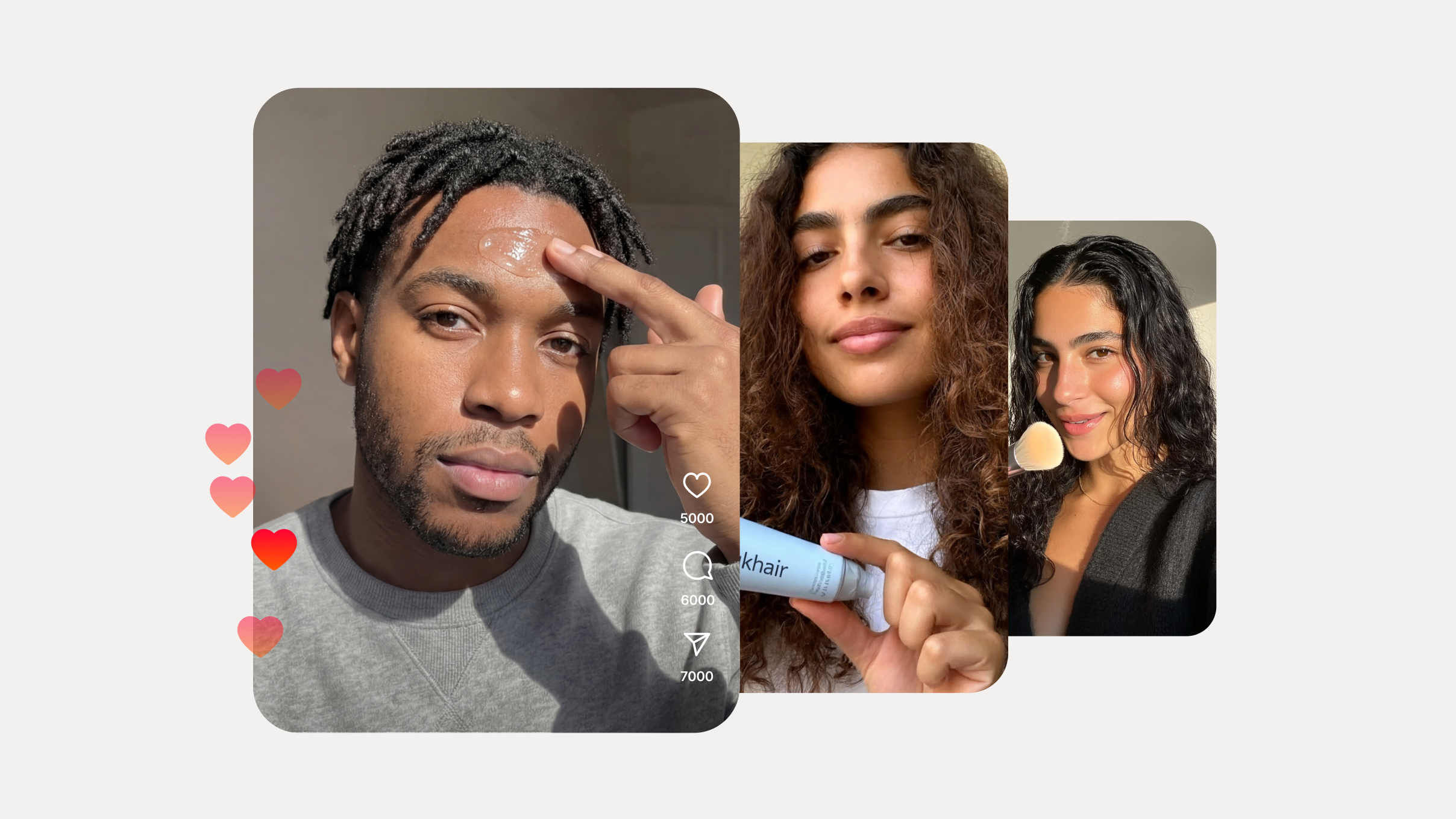
- Skincare and beauty. Before-and-after clips, routine walkthroughs, and honest first-impression reviews. UGC skincare and UGC beauty content lives on the credibility of a real face and real results.
- Fashion. Try-on hauls, styling videos, and fit checks. UGC fashion thrives on relatability, since shoppers want to see clothes on someone like them, not a model.
- Travel. Destination clips, hotel walkthroughs, and itinerary tips. UGC travel content sells the experience through a real person's eyes.
- B2B. Customer case-study clips, workflow demos, and short testimonials from named users. UGC B2B is quieter but powerful for trust in a considered purchase.
Across all of these, shoppable UGC ties the content directly to a product, so a viewer can tap from a real-looking clip straight to checkout. The vertical changes, but the principle holds: the content earns attention because it does not look like an ad.
How brands source and use user-generated content
Brands cannot create authentic UGC by definition, since it has to come from real users. What they can do is source it, generate it through campaigns, earn the right to use it, and keep it on brand. Here is how that works in practice.
Collect and commission
There are four common routes to a UGC pipeline:
- Collect organic UGC. Monitor mentions and tags, then ask customers if you can repost their content.
- Run a campaign. Give your audience a prompt and a reason to post (more on this below).
- Commission creators. Pay UGC creators directly, or work with a UGC agency to source and manage them for you. This is where "UGC creator" became a job title.
- Repurpose what you already have. Turn reviews, testimonials, and existing posts into new social videos.
Run a UGC campaign
A UGC campaign is a coordinated push to get your audience creating content for you, usually around a hashtag, a contest, or a prompt. The mechanics are simple: give people a clear ask, an incentive, and an easy way to participate, then collect and amplify the best entries. Contests and challenges work because they turn passive customers into active participants, which is the whole point of UGC.
Get the usage rights first
Before you run anyone's content as an ad, get written permission. A customer posting about you does not grant you the right to use that content in paid media. Reach out, ask explicitly, and keep a record. Usage rights are one of the most searched UGC topics for a reason, and getting it wrong is a legal and reputational risk.
Moderate what you collect
User-generated content moderation is the process of reviewing UGC before it goes live, to keep out spam, off-brand material, and anything unsafe or non-compliant. The more you invite content, the more you need a moderation step, whether that is a manual review or an automated filter. Moderation protects both your brand and your audience, and it is non-negotiable for anything user-facing at scale.
Repurpose instead of starting from scratch
Most teams are sitting on more raw material than they think. A long testimonial becomes three short clips. A blog post becomes a video summary. You can turn existing blog posts and articles into video and feed your social calendar without filming anything new.
Measure what works
Track UGC the way you track any creative: cost per result, watch time, click-through, and conversion. UGC and UGC-style ads are made to be tested, so run variations, read the numbers, and put budget behind the clips that earn it.
UGC-style media and AI UGC
UGC-style media is video made deliberately to look like authentic user content, even though a brand produced it. AI UGC is the newest version of that: generating UGC-style video from a script instead of filming it. Both are about the look and feel of real, relatable content, produced on a timeline a marketing team can actually hit.
The line worth holding onto is this. AI cannot generate authentic customer content, because authenticity comes from the source. What AI can do is produce UGC-style video fast: testimonials, product demos, and AI UGC ads that feel native, generated from a prompt or a script. This is sometimes called synthetic UGC. Used well, it closes the gap between the volume of video you need and the volume your team can film.
How AI UGC is actually made
The basic workflow is shorter than most people expect. You start with a script, either one you write or one generated from a prompt. You pick how the video should look and who should appear in it, where an AI presenter is one option among several. An AI UGC video generator produces a UGC-style clip from that script. Then you finish it, which is the step most teams underestimate and the one that decides whether the video performs.
That finishing step is the whole game. Generation gets you a raw clip that sounds right and looks roughly like a person talking to camera. It does not get you a video that looks like your brand, fits the platform, carries your call to action, and earns a place in a paid campaign. The difference between a clip and an ad is everything that happens after generation.
What AI UGC is good for, and what it isn't
AI UGC is a strong fit for a specific set of jobs:
- Volume and testing. Spin up ten script variations to find the hook that works, instead of booking one creator and waiting a week.
- Always-on formats. Product demos, explainers, and feature announcements that you need consistently and on brand.
- Speed-sensitive launches. Content tied to a drop or a moment, where filming would miss the window.
- Markets you cannot easily film in. Generating in multiple languages is faster than sourcing creators in every region.
It is a weaker fit where genuine lived experience is the point. A heartfelt customer story, a community moment, or a trend that depends on a real person's credibility should come from a real person. The smart play is not AI UGC instead of authentic UGC. It is AI UGC for the jobs it does well, and sourced authentic content for the jobs it doesn't.
Authentic UGC vs AI UGC: which to use when
The reason most teams end up using both is that they solve different problems. Authentic UGC builds trust you cannot fake. AI UGC fills the calendar you cannot keep up with.
Where VEED fits
Most AI UGC tools generate the clip and stop there, which is why so much AI UGC looks like AI UGC. VEED is built to go past generation. You create UGC-style video with VEED's AI UGC tool, then make it yours in the same place: add your product footage, drop in your branding, write the captions, and place your call to action. Generate with the latest frontier models for the raw clip, then shape the result so it reads as yours rather than templated. For a wider view of how this fits a full social workflow, see VEED's AI Studio.
This is the part that keeps AI UGC honest. The goal is never AI video that announces itself as AI video. It is video that looks like your brand made it, posted at the rate social demands.
How to make AI UGC look like your brand with VEED
Generating the clip is step one of about seven. The finishing is where a raw AI video becomes something you would actually run. Here is the workflow, in the order most teams follow it.
1. Start from a script
Write your script or type a prompt with the AI video script generator and let AI draft one you can edit. Keep it short and built around a single hook, since UGC-style video lives or dies in the first second. If you are testing, write three or four variations of the opening line rather than three full scripts. The hook is what you are really testing.
2. Generate the base clip
Generate the UGC-style video from your script. Choose the look and, if the format calls for a person on camera, the presenter. Generate a few versions so you have options to compare rather than committing to the first output. Treat this as raw material, not a finished ad.
3. Reprompt until it's right
If the first generation is not quite there, reshape it. Adjust the script, the pacing, or the delivery and generate again. This is the control step, and it is the difference between settling for what the model gave you and getting output that actually fits the brief. Do not publish the first thing that comes out. Shape it until it reads the way you would have directed it.
4. Add your own footage
Cut in real product footage, screen recordings, or B-roll. Mixing genuine clips with the generated base is what makes the final video feel grounded instead of fully synthetic. A demo lands harder when viewers see the actual product on screen, not just a description of it. This hybrid approach is one of the most reliable ways to keep UGC-style content from feeling templated.
5. Brand it
Branded content is essential. Add your logo, colors, and fonts so the video is unmistakably yours. A brand kit lets you apply the same look across every clip without rebuilding it each time. The aim is a light touch: enough that the brand is clear, not so much that the video stops feeling native. UGC works because it does not look like a polished ad, so brand with restraint.
6. Add captions
Most social video is watched on mute, so captions are not optional. Add subtitles to your videos automatically, then restyle them to match your brand. Readable, well-timed captions lift watch time and make the video accessible to viewers who cannot or will not turn the sound on.
7. Place your call to action
Drop in a text overlay or sticker as your CTA, like "Shop now," "Learn more," or "Start free trial." Position it at the moment the video has earned it, usually right after you demonstrate value or name the pain point. Use a contrasting color and a bold style so it stands out against the footage. The CTA is where a UGC-style video turns from content into a conversion.
8. Resize and reformat for each platform
One clip rarely fits every channel. Resize to 9:16 for Reels, TikTok, and Shorts, and adjust the framing so nothing important gets cropped. Reformatting and resizing videos in one place beats re-exporting from five tools, and it means a single generation can feed your whole posting schedule.
9. Scale across languages and markets
If you sell in more than one region, translate and dub your videos instead of regenerating from scratch. One strong UGC-style ad can become a dozen localized versions, which is exactly the kind of multi-market reach that filming with creators makes slow and expensive.
By the end of those steps you have moved from a script to a branded, captioned, platform-ready video with your CTA in place, without a camera, a crew, or a week of turnaround. That is the case for AI UGC: not that it replaces real creators, but that it gives a stretched team a way to produce UGC-style video at the rate the calendar actually demands.
What is a UGC creator?
A UGC creator is someone who makes UGC-style content for brands to use in their own marketing, usually short-form video, without needing a large personal following. That is the meaning behind the job title: brands pay for the content and the relatability, not the audience. It has become a real career path, and demand keeps growing as more brands shift budget into UGC-style video.
If you want to become a UGC creator, the basics are straightforward: pick a few niches you can speak to credibly, build a small portfolio of sample videos using products you already own, and practice the formats brands buy, like testimonials, demos, and unboxings. Keep your production clean, since good audio, lighting, and captions separate paid work from hobby clips. You do not need a studio or a big following to start. The deeper playbook on rates, pitching, and landing deals is a topic of its own, and one we will cover in a dedicated guide.
Best practices for using user-generated content
Getting value from UGC content is less about volume and more about how you select, polish, and deploy it. A few practices that consistently pay off.
For authentic and sourced UGC
- Always get permission. Treat usage rights as step one, not an afterthought.
- Match the format to the platform. A 9:16 demo for Reels, a punchy hook for TikTok, a slightly longer cut for YouTube.
- Credit the creator. It is good practice, and it makes people more willing to let you use their content.
- Keep your branding light. UGC works because it does not look like an ad. Add just enough so the brand is clear without killing the native feel.
For AI UGC
- Test hooks, not whole videos. Generate several openings and let performance pick the winner.
- Always mix in real footage. A generated base plus genuine product clips reads as far more authentic than a fully synthetic video.
- Never ship the raw generation. Reprompt, brand, caption, and add a CTA before anything goes live.
- Be honest in regulated categories. If a format implies a real customer experience, make sure your claims are accurate and compliant.
- Lead with the hook. The first second decides whether anyone watches the rest, generated or filmed.
Bringing it together
Here's what to remember:
- UGC content is made by real users, not brands. The source is the whole point, and the reason it builds trust.
- The term covers two things. Authentic customer content, and UGC-style or AI UGC made for ads. Keep them straight.
- It earns its place on strategy, not novelty. Run campaigns, get the rights, moderate what you collect, and measure results.
- Video is where the demand and the difficulty both are. It is the format that performs and the one that is hardest to produce at scale.
- AI fills the production gap. It produces UGC-style video fast, but the value is in the finishing: branding, captions, footage, and a CTA that make it look like your brand.
🔧 Next step: Ready to produce UGC-style video without a film crew? Create your first UGC-style video with VEED's AI UGC tool.