Make More of the Content You Already Have: Turn Long-Form into Video
Summary / Key Takeaways:
- Strategic content repurposing reduces creator overwhelm while maximizing the value of high-performing assets across multiple platforms
- Prioritize evergreen, high-leverage content with strong hooks rather than attempting to repurpose everything you create
- "Low-fi" videos can outperform polished content when you focus on speed, hooks, and audience value over perfectionism
- AI tools like Claude AI and VGNI Studio streamline video creation from scripting to production in under 20 minutes
- Each repurposed video answers specific questions, improving SEO and discoverability on platforms like TikTok, LinkedIn, and YouTube
You've already created the content. Your blog posts are performing well. Your webinars delivered value. Your podcasts resonated with listeners. So why does creating video content from scratch feel like starting over?
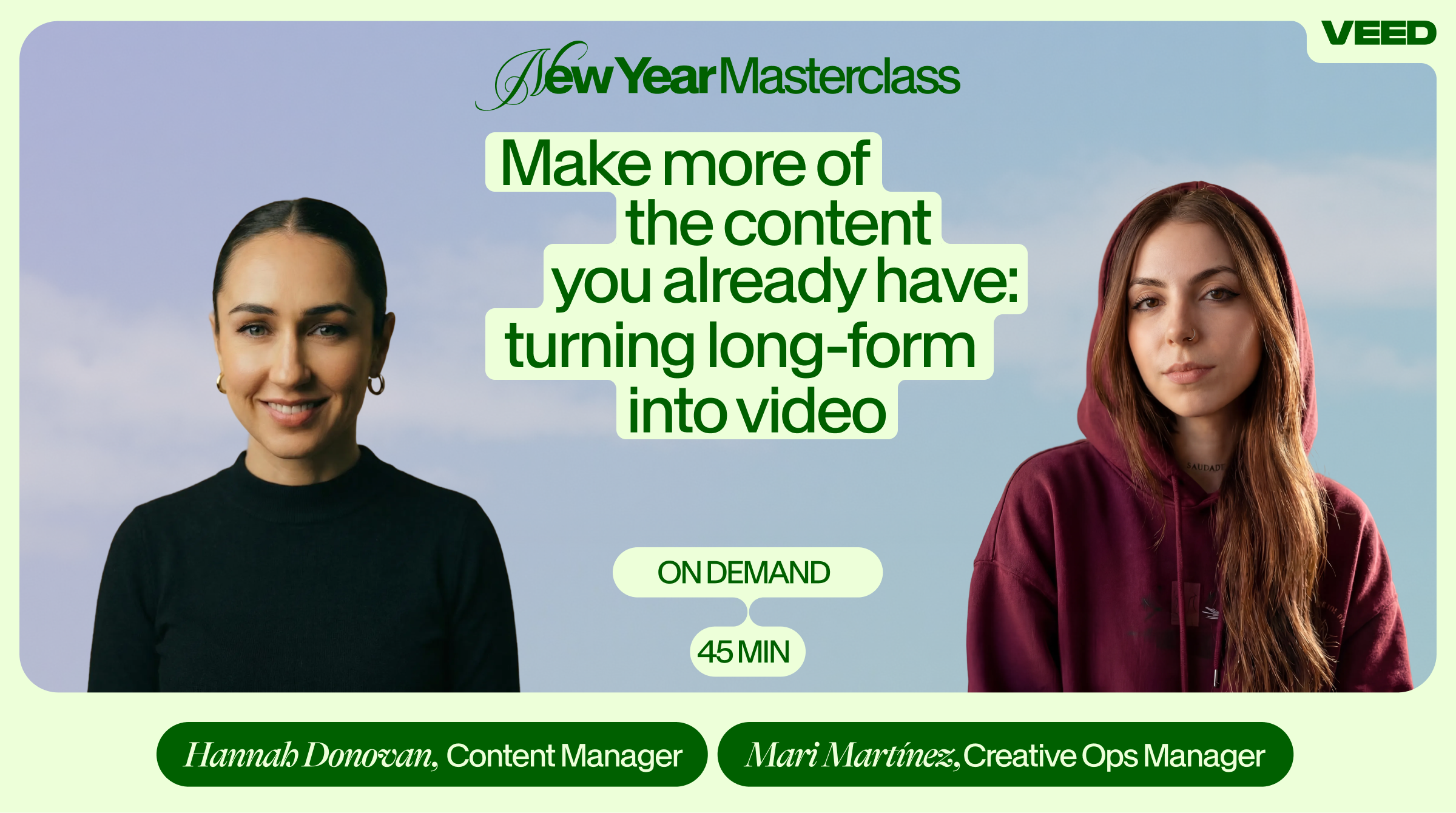
It doesn't have to. In VEED's recent master class, Hannah Donovan (Content Manager) and Mariana Martinez (Creative Ops Lead) shared battle-tested strategies for transforming long-form content into scroll-stopping short-form videos. The session, hosted by Anna Aria Harutyunyan (Sr. CRM Marketing Manager), revealed how marketers can scale video production without burning out or sacrificing quality.
This recap distills the most actionable insights from the webinar, complete with the exact workflows, tools, and mindset shifts you need to turn your existing content library into a video goldmine.
Why repurposing content beats starting from zero
Hannah opened with a reality check for content marketers: "Treating repurposing as equally important as creating new content for your schedule is absolutely game-changing."
Here's why repurposing deserves a permanent spot in your content calendar:
Reduces creator overwhelm: Constantly generating fresh ideas leads to burnout. Repurposing proven content maintains consistency while giving your creative energy a break.
Maximizes content value: If a blog post drove traffic or a webinar generated leads, those insights deserve broader reach. Short-form video makes that content easier to consume on social platforms.
Unlocks new audiences: Different platforms attract different viewers. Your LinkedIn article might not reach TikTok users, but a 60-second video version could. Hannah noted: "Consistency unlocks new channels and audiences."
Improves discoverability: Each short video targeting a specific question helps you rank on Google and platform-specific search (TikTok, YouTube, LinkedIn). Hannah emphasized: "Each short-form video responds to specific questions, which helps you rank on Google and platforms like TikTok and LinkedIn."
How to choose which content to repurpose (and which to skip)
The prioritization framework
Not all content deserves the repurposing treatment. Hannah shared a prioritization matrix based on three factors: performance, effort, and audience need.
High-leverage content: Look for pieces that performed well with minimal promotion. These are your winners—content that resonated naturally. With low effort to adapt, they're prime repurposing candidates.
Evergreen hooks: Timeless topics addressing core audience pain points deliver value regardless of when someone discovers them. These pieces continue working long after publication.
Low-risk experiments: That blog post from two years ago? It might trend now. Older or underperforming assets can find new life on different platforms with fresh audiences.
One angle, one platform: the focused approach
Here's where most marketers go wrong: trying to repurpose everything everywhere. Hannah's advice cuts through the noise:
"The goal isn't to repurpose everything everywhere. Choose one strong angle per content type and publish it where it already fits."
This focused approach means:
- Identifying the single most compelling angle in your long-form piece
- Matching that angle to the platform where it naturally belongs
- Skipping the pressure to create 47 versions for every channel
For engaging social clips, focus on: Bold, quotable lines and curiosity gaps. Hannah explained: "It's not about telling the full story; it's about hooking attention."
The 20-minute video creation workflow
Mariana's practical demo
Mariana delivered the session's most tactical segment: creating a social video from a blog post in under 20 minutes. Her philosophy? "Forget the perfectionism!"
The workflow breaks down into four steps:
- Step 1: Generate scripts with AI: Mariana recommended Claude AI for script generation: "It's fast and allows prompts to customize hooks, content sections, and calls-to-action." She transformed one blog post into five distinct video scripts, each targeting a different angle or platform.
- Step 2: Select your strongest hook: Not all scripts are created equal. Mariana demonstrated choosing hooks with high engagement potential, like: "After analyzing $100,000,000 in ad spend, we found something shocking." The curiosity gap does the heavy lifting.
- Step 3: Create footage instantlyUsing VGNI Studio, Mariana generated AI avatars, B-roll, and audio narration in minutes: "VGNI Studio creates everything—from talking heads to B-roll—instantly, saving time without sacrificing quality."
- Step 4: Add "pizza toppings" (brand polish)Small refinements make the difference between generic and on-brand:
- Dynamic subtitles with emphasized keywords
- Zoom effects on key moments
- Branded outros saved as favorites for quick reuse
Editing techniques that save time
Mariana shared specific editing tactics that accelerate production:
- Cut "millennial pauses": Remove awkward silences for tighter, more engaging videos. Every second counts in short-form content.
- Stylize subtitles strategically: Emphasize power words through size, color, or animation. Viewers should grasp your point even with sound off.
- Build a brand toolkit: Save your colors, fonts, and outro templates. Reusing these elements shaves minutes off every video.
The "low-fi can win" philosophy
Rethinking video quality standards
Mariana's most liberating insight challenged conventional wisdom about production value: "Low-fi videos can perform as well as high-production ones if tested quickly and smartly. Ugly can win, but lazy can't."
This distinction matters. "Ugly" means:
- Imperfect lighting or audio
- Simple graphics
- Minimal editing
"Lazy" means:
- Unclear messaging
- No hook or value proposition
- Generic, uninspired content
The first category can succeed if the content delivers value. The second category fails regardless of production quality.
Speed as a competitive advantage
In social media, testing velocity beats polish. Creating one perfect video per month means eleven missed learning opportunities. Creating twelve "good enough" videos reveals what resonates with your audience.
Mariana's approach: Ship fast, analyze performance, iterate based on data.
The human touch in AI-generated content
Avoiding "AI slop"
Both speakers addressed a growing concern: obviously artificial, low-quality AI content. Mariana defined it clearly: "AI slop is when it's clear that the content is bad. AI helps, but it's humans who make it meaningful."
The key distinction? AI handles production mechanics while humans provide:
- Strategic direction (which content to repurpose, for which platform)
- Creative hooks and messaging
- Brand voice and tone
- Quality control and refinement
That final layer of refinement is what separates useful AI assistance from generic output. Before publishing, many teams review drafts to transform AI text naturally so the final script feels more authentic, engaging, and aligned with their brand voice.
When audiences accept AI
Hannah offered perspective on viewer tolerance: "Audiences are willing to accept AI if the content delivers value. Always consider your goals."
This means evaluating each piece against audience expectations and platform norms. A quick LinkedIn tip video has different standards than a flagship product demo.
Best practices for scalable video repurposing
Testing and iteration
Launch imperfect videos, gather data, and refine your approach:
- Post different hooks for the same core content
- Test various thumbnail styles
- Experiment with video lengths
- Try different posting times
Performance metrics reveal what resonates far better than assumptions.
Tools mentioned in the master class
Scripting and ideation:
- Claude AI: Generate multiple script variations from long-form content with customizable prompts for hooks, body, and CTAs
Video production:
- VGNI Studio: Create AI-generated talking head videos, B-roll, and narration without recording equipment
Editing and polish:
- VEED: Edit videos, add dynamic subtitles, apply brand elements, and export optimized files for each platform
Wrapping up: your repurposing action plan
Here's what to remember from VEED's master class:
- Start with winners: Prioritize repurposing content that already performed well rather than attempting to salvage underperformers.
- Focus beats breadth: One strong angle on the right platform outperforms mediocre versions across every channel.
- Ship over polish: "Low-fi can win, but lazy won't"—speed and value matter more than production perfection.
- Let AI handle mechanics: Use tools for scripting and production while you focus on strategy, hooks, and brand voice.
- Test systematically: Create variations, analyze performance, and iterate based on data rather than assumptions.
Next Step: Audit your content library this week. Identify three high-performing pieces and create one short-form video from each using the workflow shared in this recap.
FAQ
Platform-optimal lengths vary: TikTok performs best under 60 seconds, Instagram Reels between 15-90 seconds, LinkedIn allows longer 1-3 minute videos, and YouTube Shorts caps at 60 seconds. Focus on completion rate over arbitrary length—if your content grips viewers, they'll watch longer videos.
AI tools like VEED AI Studio generate video content without cameras or recording equipment. You can create talking head videos, B-roll, and complete productions using just written scripts. Screen recordings, stock footage, and simple graphics also create effective videos without traditional filming.
Quality over quantity wins. We recommend choosing one strong angle per content piece rather than forcing multiple mediocre variations. A well-performing blog post might yield 3-5 distinct video concepts, each targeting different platforms or audience segments with unique hooks.
Performance depends on value delivery, not production method. Mariana Martinez emphasized that audiences accept AI-generated content when it provides genuine value. Test both approaches and let metrics guide decisions—some AI videos outperform expensive productions because the hook and messaging resonate better.
Build a brand toolkit with saved templates, color palettes, fonts, and outros in your editing software. This lets you apply consistent branding in seconds rather than recreating elements for each video. Hannah and Mariana both emphasized that systems enable speed without sacrificing brand recognition.
Use Claude AI or similar tools with specific prompts: provide your blog URL or text, specify desired length (30-90 seconds), request 3-5 hook variations, and ask for platform-specific adaptations. Review and refine the output rather than writing from scratch. This process takes 5-10 minutes versus 30-60 minutes for manual scripting.