
Video is great at grabbing attention. But even in the video space there’s a lot of competition. For instance, YouTube alone grows by 500 hours every single minute.
Simply put: making a video without focusing on engagement isn’t going to cut it.
Yet, video is worth the effort. The average person watches 17 hours of video content each week. The same applies to our work lives, which is why a lot of businesses are moving towards a video-first culture.
If you can cut through the noise, it could be your videos people are watching. And even better, it could be your videos that are driving valuable business impact.
In this piece, we'll dive into 4 key tips that will help you create videos that aren't just attention-grabbing, but also attention-retaining.
Jump to a specific section:
- Consideration Span Versus Attention Span
- Tip 1: Start Off with Content Value
- Tip 2: Create Compelling Hooks
- Tip 3: Experiment with Pace and Length
- Tip 4: Spice Up with Visuals and Fun
[#TOC1]Consideration Span Versus Attention Span[#TOC1]
Grabbing people's attention is just the first step. Keeping it throughout the video is the rest of the effort. This is where the concept of consideration and attention spans comes into play.
In the context of videos:
- Consideration span is the brief period in which a person decides whether they want to engage with a video or not.
- Attention span is how long someone engages with a particular video once they’ve clicked on it.
The key to winning is to figure out how to capture your viewer's attention (win at the consideration stage) and then keep that attention (win at the attention stage).
But where do you start?
Starting with the consideration stage. For social media platforms, this means looking at things like clickthrough rates (how many clicks a video gets), measuring how different types of titles and thumbnails fair against each other, and running tests between two versions of the same video (A/B testing).
For internal comms or training, look at similar metrics. Are people clicking the videos? Watching them all the way through? Passing any product-related tests following the videos? Responding to your sales reps?
Once again, run A/B tests for your videos, regardless of use case, and make small incremental tweaks to figure out what performs the best.
To address attention span, you can take a similar approach. Albeit, attention span is a little more intensive, as it involves making the actual video worth watching. Still, you can look for trends, identify which videos perform the best, and try replicating that success through experimentation.
4 Tips to Make Attention-Grabbing Videos
While there’s no silver bullet for grabbing attention, as every audience and industry is unique, there are several guiding principles you can put in place to set a strong foundation.
The following tips apply to virtually all kinds of videos:
[#TOC2]Start Off with Content Value[#TOC2]
First, and most importantly, you need to focus on the value the content provides. Ask yourself:
- Why are you creating the video?
- Why should your audience care?
- What does your audience know about this topic?
- What can you tell them they don’t already know?
- How can you tell the story?
When you can answer the above, you’re well on your way to answering an even bigger question: how can you add more value and make your audience stick around?
Take our video on creating testimonials as an example:
This video answers the above questions with clear responses:
- Why are we creating the video? To educate our audience on how to make video testimonials.
- Why should our audience care? Effective video testimonials can help build trust in an authentic way.
- What does our audience know about this topic? They know what testimonials are.
- What can you tell them they don’t already know? About the different types of video testimonials, as well as how to use VEED to make these videos quickly and professionally.
- How can we tell the story? In the form of a high-quality and engaging talking head video, that turns the process into a formula or a playbook.
If your idea for a video can’t provide succinct answers to the above questions, go back to the drawing board.
A video full of fluff, or a video repeating what’s already out there, is unlikely to gain traction.
While a compelling title or thumbnail, or even a nice opening hook, might help your audience get through consideration, their attention could trail off if the video itself isn’t meaty.
This is especially true when you’re creating videos for a discerning audience, who can smell mediocrity and fluff from miles away (think a busy sales leader whom you're pitching your latest CRM platform with a video sales deck).
As a general rule of thumb, your video should check one of the following boxes for it to qualify as 'good content':
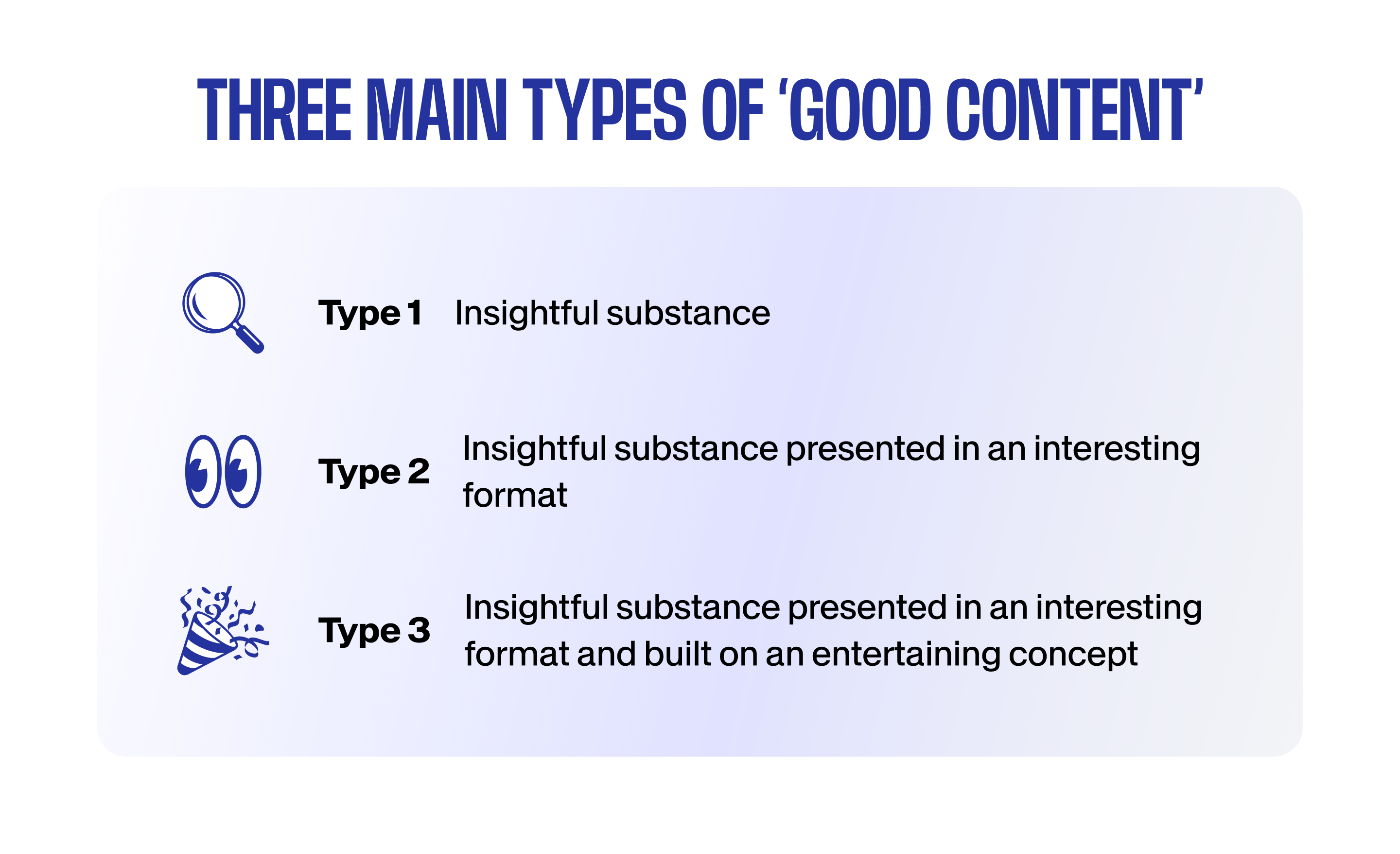
Remember: You don’t always have to reinvent the wheel and say something wholly new.
But you have to make it interesting or entertaining, at the very least. This is what will help you win at the so-called attention stage we went through earlier.
[#TOC3]Create Compelling Hooks[#TOC3]
Everyone’s been caught by a compelling hook. A hook is a unique spin or pitch of a topic that compels you to take the next step.
When it comes to video, a hook is key. It is what will help you win at the consideration stage.
Your hooks should be uniquely yours and creative, but there are still a few best practices that can help you craft a great one:
- Tease: hint at the answer to the big question posed by the video, but don't give the full answer right away. Example: Collaborating on video projects is hell. But did you know there's a tool that makes it easy?
- Surprise: shock your audience with an unexpected pitch or interesting tidbit. Example: On top of this, this video platform is easy to use, and free to start with.
- Drive FOMO: make your audiences feel like they're missing out if they don't watch the video. Example: Your competitors are likely using this tool or one that’s similar, but there’s still time to catch up.
- Rehook: use various cues, like additional visuals or sounds to keep your audience's attention. Example: See how VEED makes it easy to add in professional transitions? (Cue professional transition examples.)
- Close the Loop: during the beginning, hint at an additional tip you'll cover at the end and let your audience "close the loop" only by finishing the video (and extend the attention span). Example: It’s easy to get started with VEED. Did we mention it’s free to start?
When in doubt, look to your industry for inspiration as well. There are likely some companies doing a stellar job with B2B video hooks.
But keep in mind, you still want to make yours unique.
The below case study video from Slack, featuring Sandwich Video, is a great example.
It has a casual, interview-style intro.
From there, they quickly hook the viewer by describing their bloated communication flow, which is shockingly similar to how many organizations did things before using Slack.
Hook, line, and sinker.
[#TOC4]Experiment with Pace and Length[#TOC4]
A video that doesn’t overstay its welcome and has an engaging pace is what you’re aiming for. This is what will help you retain the undivided attention of your viewers till the very end of your video.
Keep in mind, not every video has to be super long. Nor does it have to be short. Think about the goal of the video, the amount of ground you want to cover, and the audience.
- Is it a product announcement video for social? Consider making it brief.
- Is it a deep dive of your new product or tech, like a sales demo? Consider making it comprehensive and in-depth.
- Is it a customer testimonial mashup? Think about making it brief and punchy.
- Is it a case study? Make it detailed and share all the necessary details without making it longer than necessary.
Beyond length, think about the pacing itself. A video can be short and feel long if the pacing is off. On the other end of the spectrum, the right pace can make a long video fly by.
But how do you determine the right pace?
If you’ve shared your video on a platform that lets you dive deep into the analytics (such as YouTube), look at any existing videos you’ve shared. Note where there are dips in engagement / where people have bounced off the video.
Ryan Hall, YouTube content creator at VEED, also recommends looking at retention rate (i.e. the % of viewers who stick around till the end of your video). Videos with higher retention rate most likely also have the right pace which is necessary for engagement.
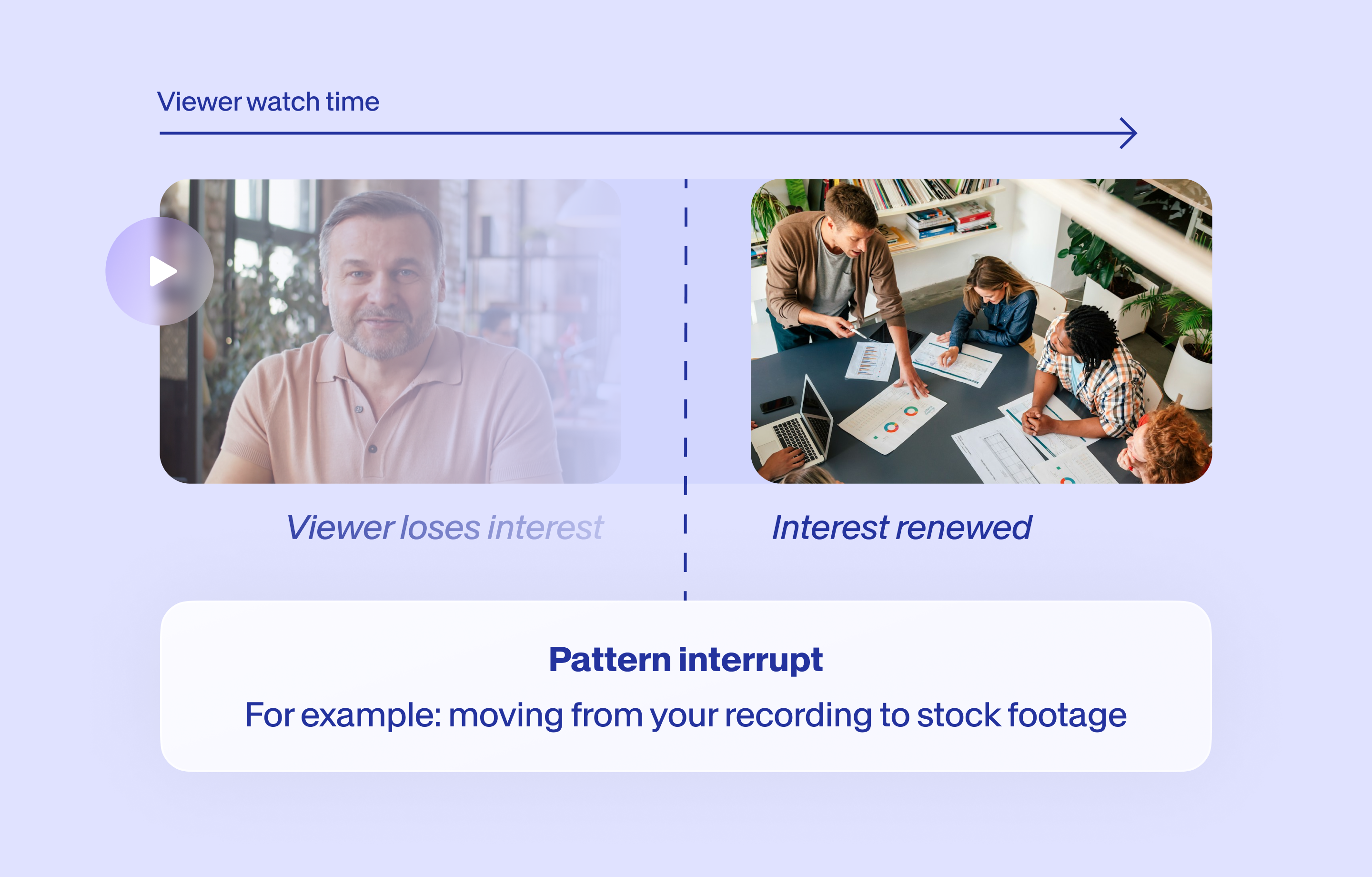
When it comes to improving retention rate, Ryan, along with the rest of the video team at VEED recommend a technique known as pattern interrupt.
Pattern interrupt: To break the typical pattern of behavior or thought of the viewer.
Pattern interrupt is a sudden shift in scenery, changing on-screen elements, throwing in a sound effect or shift in background music, and so on.
Instead of having a monotonous talking head video where it's just the subject speaking into the camera, you also throw these auditory and visual elements throughout the clip.
This helps in renewing the interest of the viewer, bringing their attention back to the video.
The below example from SurveyMonkey really showcases the impact a brisk pace and length can have. The video also utilizes pattern interrupt to the fullest, with each scene featuring different styles of animation and transitions, without overdoing it.
[#TOC5]Spice Up with Visuals and Fun[#TOC5]
Lastly, spice up the video with entertaining and engaging visuals, editing, and sounds. Video, unlike written or image-based content, has the blessing of flexibility and versatility. Take advantage and incorporate the following tips to spice things up:
- Use b-roll footage to break up longer shots.
- Vary your zoom, with some shots being tight and others panning out.
- Incorporate background music and engaging sounds.
- Add subtitles and animations to bring visual flair to shots.
- Feature animations and graphics where it makes sense.
One of our customers, Whirlpool Canada, puts it best:
“We did a fun video... It was very low production value — we just shot it in our product room, but we were able to use VEED to give it a TikTok vibe with the voice and fun emojis. It was truly the most popular single piece of content we released this year, to a great extent!”
—Yvonne Gettins, Training Content Designer, Whirlpool Canada
If you’re looking to make engaging, attention-grabbing videos easier than ever before, try VEED today. We streamline the video creation and collaboration process with AI, empowering your team to create better, more impactful videos. The end result?
Professional-grade videos that not only catch the viewer’s attention, but also keep it.


